

When a small warning becomes a big incident
Security incidents rarely begin with an obvious alarm. More often, they start with subtle warning signs: an employee receives an unusual message, notices an unfamiliar login, observes unexpected file behaviour or experiences a sudden slowdown in system performance. The first reaction is often not to report the incident, but to assume that it is probably nothing.
This hesitation can have significant consequences. In cybersecurity, time plays a critical role. The decisive moment is often not when a system is compromised, but when suspicious activity is reported. The earlier a potential threat reaches the responsible security team, the more opportunities there are to investigate, contain and recover from an incident.
Reporting does not mean diagnosing an incident. It means communicating a potential threat to someone who can assess it. A report that turns out to be harmless may only require a few minutes to investigate. An unreported incident that turns out to be genuine can result in costs of hundreds of thousands.
A real-world reporting scenario
08:17
An employee receives an unusual Microsoft 365 sign-in prompt.
08:24
After successfully signing in, a second MFA request appears unexpectedly.
08:31
Instead of waiting, the employee reports the activity through the defined security channel.
08:38
The security team begins its investigation and triage.
08:52
The account is locked, active sessions are terminated and further analysis begins.
Now ask yourself:
What would have happened if the incident had only been reported after lunch?
Several additional hours could have allowed an attacker to access data, create persistence or move laterally through the environment. This is why Mean Time to Report is becoming an increasingly important cybersecurity metric.
Why do people wait before reporting?
The reasons are often less technical than organisations expect. One of the most common barriers is uncertainty: employees may believe they need to know exactly what happened before reporting suspicious activity.
Others hesitate because they fear being blamed for clicking a link or opening an attachment, or because they do not want to waste the security team’s time with a false alarm. Waiting for more information may seem responsible, but every minute of delay can give attackers more time to operate, particularly as AI-driven attacks become increasingly automated.
Complex reporting processes create additional barriers. If employees need to find the correct email address, complete a lengthy form or navigate an unfamiliar ticketing system, they may postpone reporting. What starts as a delay can result in an incident never being reported.
Previous experiences also influence reporting behaviour. If earlier reports received no feedback or colleagues were criticised for raising false alarms, employees may become reluctant to report future concerns. Combined with alert fatigue and unclear responsibilities across IT, security and business teams, these factors can further delay incident reporting.
The earlier employees report suspicious activity, the greater the chance of keeping a small security incident small.
What late reporting actually costs
Je länger ein Vorfall unentdeckt oder ungelöst bleibt, desto grösser sind die potenziellen finanziellen Auswirkungen.
The longer an incident remains undetected or unresolved, the greater its potential financial impact.
According to IBM’s Cost of a Data Breach Report 2025, the global average time to identify and contain a breach is 241 days, approximately 181 days to detect the breach and a further 60 days to contain it. This represents more than eight months during which attackers may remain active, move data and cause additional damage. Every additional day of attacker dwell time can increase the overall cost.
How a breach is discovered also makes a difference. When an organisation’s own security team detects an incident, the average cost is approximately USD 4.18 million. When attackers disclose the breach themselves, through an extortion demand or a public leak, the average cost increases to approximately USD 5.08 million.
This difference of nearly USD 1 million highlights the financial impact of delayed detection and response. Beyond direct costs, delayed or incomplete disclosure can also damage customer and partner trust, which may be more difficult to restore than the affected technical systems.
In Switzerland, reporting is now a legal deadline
Timely reporting is no longer only a matter of security culture. It is also a regulatory requirement for certain organisations.
Since 1 April 2025, operators of critical infrastructure in Switzerland have been required to report cyberattacks to the National Cyber Security Centre (NCSC) within 24 hours of discovery, with a further 14 days to complete the report. Since 1 October 2025, failure to comply with the reporting obligation can result in fines of up to CHF 100,000.
Under the GDPR, a 72-hour notification period applies to many personal data breaches, while sector-specific regulations may impose additional deadlines.
For an increasing number of organisations, the time between identifying suspicious activity and reporting it is therefore not only an internal security metric but also a compliance consideration.
How to shorten the reporting window
Organisations that consistently report incidents earlier share several common practices.
They establish a non-punitive reporting culture and communicate this clearly across all levels of the organisation, starting with leadership. They provide a simple, well-known reporting channel, such as a dedicated email address, a chat function or an integrated reporting feature within everyday tools. This makes it easier for employees to raise concerns without unnecessary effort.
They also keep initial reporting requirements simple. Information about what happened, when it occurred and what the employee observed is usually sufficient to begin an assessment.
Providing feedback is equally important. When employees understand what happened after submitting a report, it reinforces positive reporting behaviour and builds trust in the process.
Regular training and practical exercises help make these procedures part of everyday operations. Awareness training should cover not only how to recognise phishing attempts but also which early warning signs require escalation.
Tabletop exercises and simulated incidents allow employees to practise reporting decisions before a real security event occurs. Measuring mean time to report as a key performance indicator helps organisations track progress and maintain management attention.
Technology also supports faster reporting. Centralised logging, SIEM and SOAR platforms, endpoint telemetry and integrated reporting functions can reduce the time between identifying a suspicious signal and taking action.
However, technology cannot replace human awareness. Employees are often the first to notice suspicious supplier requests, unusual phone calls or other activities that automated security controls may not detect.
The most effective approach combines both capabilities: automated systems correlate signals quickly, while employees provide the context needed to assess potential threats.
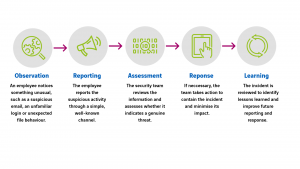
Effective incident reporting follows a simple sequence. The challenge is not building the process, but ensuring employees use it immediately when something suspicious occurs.
Four questions for your next leadership meeting
Answer the following questions honestly
- Do employees know what suspicious activity should be reported?
- Do they know exactly where and how to report it
- Can they report concerns without fear of blame or negative consequences?
- Do you measure your Mean Time to Report?
- Do you regularly test reporting procedures through tabletop exercises?
Any question that cannot be answered clearly may indicate a gap in existing processes or responsibilities.
More resilience through faster reporting
Security incidents will remain part of the business landscape. What distinguishes organisations that successfully limit their impact is not necessarily the sophistication of their technology, but how quickly they move from identifying suspicious activity to reporting, assessment, response and continuous improvement.
Removing reporting barriers, providing accessible communication channels and measuring response times help organisations strengthen their security posture.
The cost of delayed reporting is measurable, and the benefits of faster action can be significant. Ultimately, the objective is simple: make the safest action the easiest action.
How Axians supports faster incident reporting
From gaps in reporting to willingness to report
Axians supports clients in strengthening both the organisational and technical aspects of incident reporting.
We review existing reporting and escalation processes and help develop simple, accessible reporting channels integrated into an Information Security Management System (ISMS) aligned with ISO/IEC 27001:2022.
Our experts provide awareness training and tabletop exercises that allow employees to practise reporting procedures before a real incident occurs. We also help organisations define and measure mean time to report.
In addition, we advise on Swiss NCSC reporting obligations and GDPR requirements, helping organisations establish processes that support both security and compliance objectives.
Looking ahead
Two developments are making timely incident reporting increasingly important.
First, attackers are increasingly using AI to automate attacks, reducing the time available for defenders to react. Second, regulatory requirements continue to evolve. Switzerland’s NCSC reporting obligation is now enforceable, while the EU’s NIS2 Directive extends mandatory incident reporting requirements to a broader range of organisations.
In response, leading organisations are treating mean time to report as a board-level metric and integrating one-click reporting functions into everyday tools.
The benefits of security automation are measurable. According to IBM’s Cost of a Data Breach Report 2025, organisations making extensive use of security AI and automation identified and contained breaches approximately 80 days faster and achieved average savings of USD 1.9 million.
A practical next step is to establish a baseline for current reporting times and test existing procedures through a tabletop exercise.
ALEKSANDAR STOJANOVIC
Information Security Consultant, Axians BNC