From Secure Score to true cyber resilience
Despite significant investments in Microsoft security solutions, many security leaders at Swiss companies still face the question of how resilient their security architecture really is. A good security score alone does not create cyber resilience. What matters is how consistently companies identify, prioritize and continuously reduce risks in their day-to-day operations.
Cybersecurity is constantly evolving. New devices are being added, cloud environments are growing, permissions are changing and AI-powered applications are accessing increasing amounts of data. As a result, new risks and dependencies are constantly emerging.
Yet many companies still operate largely reactively. Security measures are often introduced following audits, regulatory requirements or specific incidents. Assessments provide a snapshot in time, but not a continuous improvement process. This is precisely where one of the biggest challenges of modern security strategies lies.
More transparency does not automatically mean more security
Most companies already have access to extensive security data. Microsoft Defender, Sentinel, Entra and Purview continuously provide information about devices, identities, access, cloud activities and data flows.
But data alone does not provide clarity. In their day-to-day work, security teams struggle with:
- a high number of alerts
- manual prioritization
- a lack of context
- unclear attack paths
- isolated security information
This creates operational friction. Risks remain unresolved for longer, and teams lose valuable time assessing incidents.
Modern security platforms therefore take a different approach. They connect information from different areas to create a shared view of the overall security landscape.
An individual risk often appears harmless in isolation. It only becomes critical when combined with other vulnerabilities, such as overly broad permissions, unusual user activity or unprotected sensitive data. Today, this context is crucial to the effectiveness of security operations.
Security must become continuously manageable
Modern SecOps also changes the perspective on cybersecurity. The focus is no longer on the number of individual security measures, but on the ability to make risks continuously visible and manageable.
Modern platform capabilities such as Secure Score, Exposure Management and Attack Path Analysis help companies to:
- identify security gaps at an early stage
- prioritize risks based on relevance
- make critical attack paths visible
- systematically improve security measures
- continuously measure progress
Security thus evolves from a static assessment into a continuous improvement process. This not only reduces the burden on security teams, but also creates greater transparency for management, compliance stakeholders and regulatory requirements.
For Swiss companies in particular, this ability to manage security continuously is becoming increasingly important. Data protection, governance and transparent security processes play a central role across many industries.
AI increases the pressure on security and governance
The growing use of AI is adding further momentum. Companies are increasingly integrating Copilot and AI capabilities into their work processes. At the same time, clear structures for data classification, access control and governance are often still lacking. As a result, data security is becoming an increasingly important part of modern cybersecurity.
Today, companies need to understand:
- which data is sensitive
- who has access to it
- how information is used
- what risks arise from AI-powered applications
AI is therefore changing more than just processes and productivity. It is also increasing the requirements for transparency and security management.
From security measurement to true resilience
Many companies already have the technological foundation for modern cybersecurity in place. The crucial next step is to continuously improve security instead of responding to risks only on an ad hoc basis.
Modern SecOps brings together platforms, processes, governance and continuous optimization to create an integrated security model.
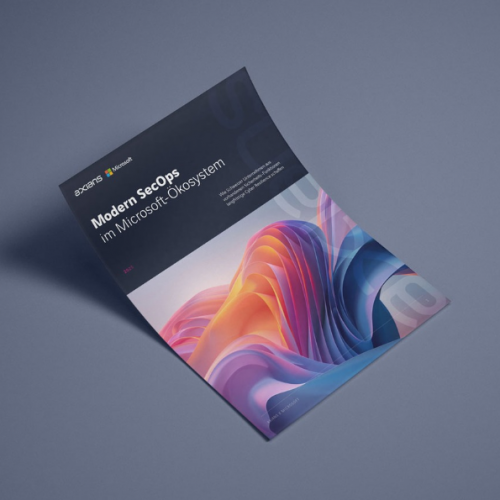
The latest ePaper from Axians Somnitec and Microsoft shows how companies can systematically evolve their Microsoft Security environment and make cyber resilience measurable.
VISNU IMMER
Security Operations Consultant