Why Microsoft Security is rarely the problem – but a lack of orchestration is
Swiss companies have invested heavily in cyber security in recent years. Microsoft 365 has been expanded, cloud environments have been built, security capabilities have been activated and new compliance requirements have been implemented. Today, many organisations already have a strong technological foundation. Nevertheless, the operational impact of security often falls short of expectations.
Most companies in Switzerland now have significantly more security data than they did just a few years ago. Endpoints, user accounts, cloud services and applications continuously generate new signals. At the same time, regulatory requirements, cyber risks and management expectations regarding transparency and control are increasing. As a result, operational complexity is growing as well.
Security teams work with different dashboards, assess alerts manually and often prioritise risks under considerable time pressure. Information from identities, devices, data access and cloud environments is not consistently brought together. As a result, the very context required for fast and reliable decisions is often missing. The real problem, therefore, is often not the technology itself. It lies between the systems.
Individual tools alone do not create effective security operations
Many organisations still approach security primarily through individual solutions. Defender protects endpoints, Entra manages identities, Purview classifies data and Sentinel analyses security events. But only by bringing this information together can organisations establish a complete picture of their security posture.
A suspicious login alone reveals very little. The situation only becomes critical when unusual device activity also occurs, sensitive data is affected or risky permissions are involved. Modern cyberattacks rarely occur in isolation. They move across different layers of the IT environment.
This is precisely why cyber security is increasingly evolving from a collection of tools towards a platform approach. The Microsoft Unified Security Platform connects identities, endpoints, cloud services, applications and data within a shared security context. This makes it possible not only to detect risks, but also to assess and prioritise them more effectively.
Security becomes an operational responsibility
This development is also changing the role of security within organisations. Today, cyber security is increasingly viewed not as a one-off IT project, but as a continuous operational process.
Because security risks are constantly changing:
- new devices are added
- cloud environments continue to grow
- permissions change
- data is distributed across different platforms
- AI-powered applications access an increasing amount of information
A point-in-time approach to security is therefore no longer sufficient.
This is exactly where Modern SecOps comes in. The approach combines protection, detection, response, governance and continuous optimisation into an integrated operating model. This makes security more measurable, manageable and operationally resilient.
The central question is no longer: Which security tools do we use? Instead, it is: How effectively do we manage security in our day-to-day operations?
L’IA accentue encore la pression
This development is particularly evident today when it comes to the use of AI. Many companies are introducing Copilot or AI capabilities without yet having full transparency into sensitive data, access rights or existing risks.
As a result, data security is moving further into focus. Today, companies need to know:
- which information is sensitive
- who has access to it
- how data is being used
- and which risks arise from sharing or AI applications
In Switzerland in particular, data protection, governance and the responsible handling of information play a central role. AI therefore not only creates new opportunities. At the same time, it makes existing security gaps more visible.
Would you like to strategically develop your Microsoft Security environment?
Our experts support you in creating transparency around existing risks, identifying opportunities for optimisation and defining a practical path towards Modern SecOps.
From Security Capabilities to Modern SecOps
A large part of the technological foundation for modern cyber security is therefore already in place. The next step is to orchestrate these capabilities and develop them into integrated security operations.
This is exactly what Modern SecOps is about. The focus is not on individual tools, but on the interaction between platform, processes, governance and continuous optimisation. Only then can true cyber resilience be achieved.
From Security Capabilities to Modern SecOps
A large part of the technological foundation for modern cybersecurity is therefore already in place. The next step is to orchestrate these capabilities and develop them into an integrated security operation.
This is exactly what Modern SecOps is about. The focus is not on individual tools, but on the interplay of platforms, processes, governance and continuous optimization. This is what ultimately creates true cyber resilience.
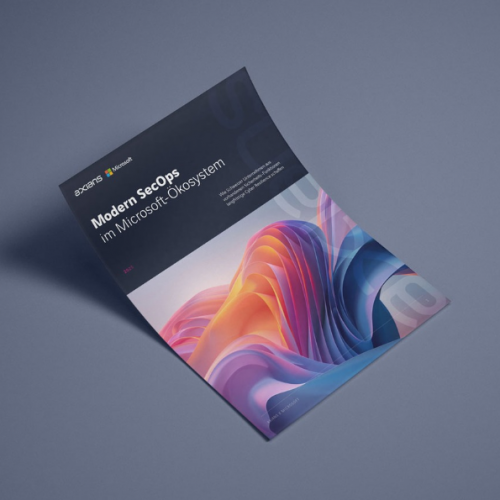
How companies can systematically evolve their Microsoft Security environment towards Modern SecOps and the role platform orchestration plays in this process are explored in the latest ePaper from Axians Somnitec and Microsoft.
VISNU IMMER
Security Operations Consultant, Axians Somnitec