

Why do customers request Security Questionnaires?
No company operates entirely on its own. Businesses rely on external services in one form or another, and these dependencies involve shared responsibilities. When a vendor handles company data or supports critical infrastructure, their security practices become relevant to the organization’s own security posture.
Before entrusting a provider with sensitive data or critical systems, companies need a clear understanding of how their information and systems are protected. Assessing this requires more than trust; it requires reliable and structured information.
This is where Security Questionnaires come into play. They are an important tool in third-party risk management (TPRM), providing companies with a structured way to assess a vendor’s security controls, verify regulatory compliance, and identify potential gaps before entering into a business relationship.
Why can answering them be challenging?
In principle, most organizations are familiar with their own security practices. In practice, however, completing a Security Questionnaire can require considerably more time than the individual questions might suggest. Several factors contribute to this.
Lack of a standardized format: Frameworks such as the Standardized Information Gathering Questionnaire (SIG) or the Consensus Assessments Initiative Questionnaire (CAIQ) are widely used. However, many customers rely on their own questionnaires. As a result, organizations receive requests that cover similar topics but differ in structure, terminology, and level of detail. This often means that the same information needs to be reformulated several times.
Fragmented ownership of information: The information required for a questionnaire is rarely held by one person or team. Security policies may be managed by the security team, access control details by IT, data handling practices by engineering, and compliance certifications by legal or Governance, Risk and Compliance (GRC) teams. Completing a questionnaire therefore often requires coordination across several departments.
Evidence that can be difficult to locate or provide on demand: Even when a security control is well established, the corresponding documentation, such as audit reports, policies, or technical configurations, may not be centrally available or up to date. Locating or updating this evidence can require more time than describing the control itself.
Volume and recurrence: Larger organizations and companies operating in regulated industries may receive Security Questionnaires from multiple customers or prospects on a recurring basis. Without a repeatable process, each request can become an individual project and require considerable resources.
Sensitivity of the information requested: Some questions address sensitive topics such as internal architecture, vulnerabilities, or subcontractor relationships. Responses therefore need to provide the required transparency while maintaining an appropriate level of confidentiality.
How can the response process be organized efficiently?
Standardize the output format: Instead of preparing each response from scratch according to the customer’s template, organizations can maintain a central master document based on a question-and-answer structure. The relevant content can then be transferred into different formats, such as spreadsheets, PDFs, or customer portals.
Map content across frameworks: Questions from different frameworks often address similar requirements. Creating cross-references between equivalent questions makes it easier to identify and reuse existing answers.
Track process metrics: Measuring response times, answer reuse, and escalations to subject-matter experts can help identify bottlenecks and determine whether further investment in tools or automation could provide additional value.
Review and update the answer library regularly: Answers can become outdated as tools, certifications, and policies change. A scheduled review, for example on a quarterly basis, can help ensure that customers receive current information.
Maintain answers at different levels of detail: Some customers require concise, high-level responses, while others expect detailed technical explanations. Preparing both short and detailed versions of frequently used answers can reduce the need to rewrite the same information for different requirements.
Establish clear criteria for scoping conversations: Generic questionnaires may contain sections that are not relevant to the service in question. Defining when to ask a customer to narrow the scope, for example when payment card processing is not applicable, can make the process more efficient for both parties.
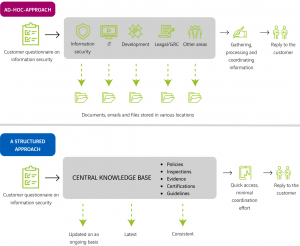
How does ISO 27001 support and streamline this process?
A significant part of the effort involved in completing Security Questionnaires comes from having to explain how information security is managed across the organization. ISO 27001 certification can simplify this process by providing a recognized reference point for many of the topics covered by these questionnaires.
It does not eliminate the underlying work, but it provides an established framework that can address many requirements in a structured way.
It covers many of the areas addressed in Security Questionnaires. ISO 27001 requires a documented Information Security Management System (ISMS) covering areas such as governance, risk management, access control, incident response, business continuity, and supplier relationships. These are also common topics in Security Questionnaires.
It provides independent verification: Certification is granted following an assessment by an accredited external auditor who reviews the organization’s ISMS. This provides independent assurance that the defined requirements are being addressed.
It can reduce the need for individual explanations. Instead of describing each security practice separately, organizations can refer to an established and audited management system and provide the corresponding evidence where appropriate.
ISO 27001 therefore does not replace Security Questionnaires, but it can help reduce the effort required to complete them.
How Axians can help
Third-party risk management continues to play an important role in cybersecurity, driven by regulatory requirements and increasingly complex supply chains. As a result, Security Questionnaires are likely to remain an important part of assessing third-party security risks.
In our next article, ISMS Automation: Where Can Tools Really Add Value?, we look at the role automation can play within an ISO 27001-aligned ISMS. We examine where automation can provide meaningful support and where other approaches remain necessary.
If you are looking for support with Security Questionnaires, ISO 27001, or third-party risk management, Axians can help you establish efficient and structured processes.
Contact us to discuss your requirements.
VIKTORYIA SHUTSKO
Information Security Consultant, Axians BNC